
The Beastly Blog
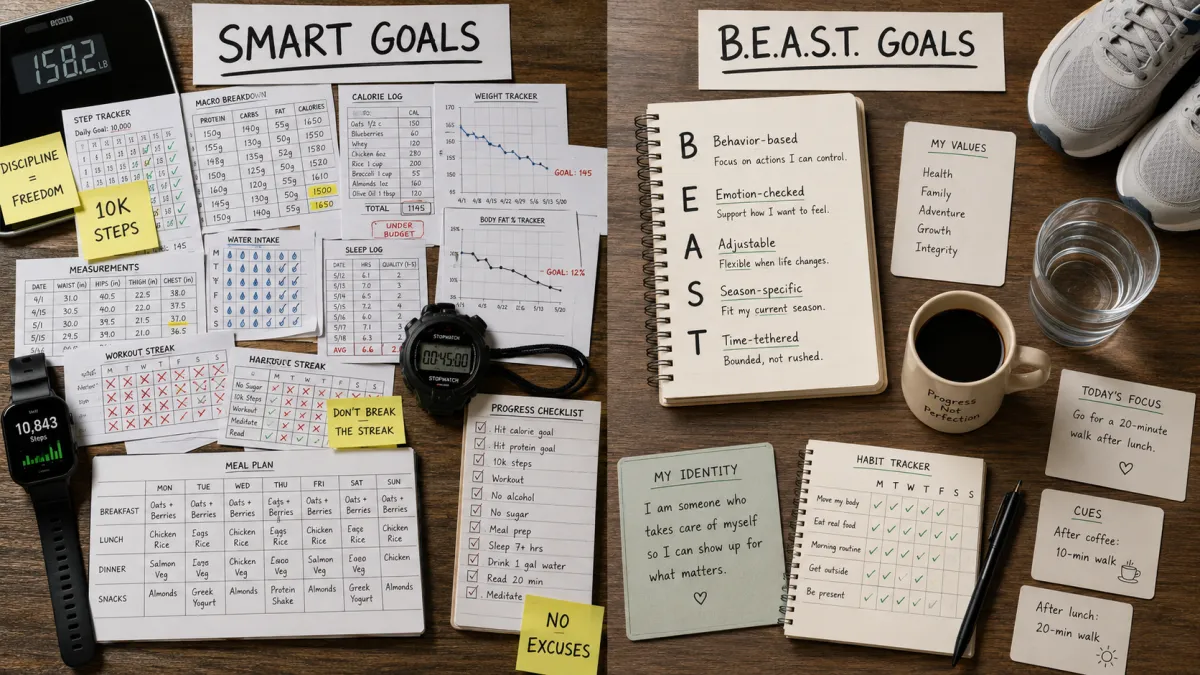
SMART Goals Are Dumb: A Better Way to Build Habits That Actually Stick
Photo by Chad
SMART goals sound like something responsible adults are supposed to love. They sound organized, practical, professional, and like they belong in a binder with color-coded tabs. And honestly, sometimes they are helpful. They can turn a vague idea into an actual plan, and that matters. The problem is not that SMART goals are completely useless. The problem is that they are often treated like the gold standard for every type of goal, even when the goal involves a real human body, a real nervous system, a real schedule, and a real life that refuses to behave.
If you have ever set a goal that sounded amazing on paper and then watched it fall apart the second real life showed up, you are not alone. You are not broken. You are not automatically lazy, undisciplined, or bad at follow-through. Sometimes the issue is not you. Sometimes the issue is that SMART goal setting is the wrong tool for real-life human habits.
SMART goals can be great for projects. They can help with deadlines, tasks, events, and things that need clear structure. But when we start using them for health habits, movement, eating, sleep, stress, and all the other messy human stuff, they can start creating pressure instead of progress. You are not a robot that can be fixed with a tighter schedule. You are a whole human with feelings, responsibilities, stress, capacity limits, and probably a snack drawer.
So let’s talk about what SMART goals actually are, why they can backfire, and what I use instead.
First, What Are SMART Goals?
SMART is a goal-setting framework that stands for Specific, Measurable, Achievable, Relevant, and Time-bound. It is widely taught in professional spaces, including NASM, the National Academy of Sports Medicine, where I got my training. So if you love SMART goals, you are not wrong and you are not basic. You are using a very common, widely taught framework. I’m just saying that this system is great for building IKEA furniture, and sometimes less great for building a consistent human with feelings and a snack drawer.
Specific means you get clear about what you are actually doing. Instead of saying you want to “get healthier,” you choose something concrete, like strength training, walking, stretching, cooking at home, or adding more protein to breakfast. It takes a fuzzy idea and gives it a job description.
Measurable means you can track the goal in some way. That might be the number of workouts you complete, how many minutes you walk, how many days per week you cook at home, or how often you practice a habit. Basically, it gives your brain receipts.
Achievable means the goal is supposed to be realistic for you. Not realistic for a wellness influencer with no visible responsibilities and a fridge full of pre-cut fruit. Realistic for your life, your time, your energy, and your capacity.
Relevant means the goal actually matters to you and connects to your values. Not something you copied from the internet because it sounded impressive. Not something you chose because diet culture, hustle culture, or your friend who wakes up at 4:45 a.m. made it sound morally superior.
Time-bound means there is some kind of timeframe attached. Maybe it is for the next eight weeks, by the end of the month, or three times per week. It gives the goal a calendar instead of letting it float around as a someday dream.
So instead of saying, “I want to get healthier,” a SMART version might be something like doing strength training three times per week for 30 minutes for the next eight weeks. On paper, that sounds much more useful. It is the difference between a wish and a plan. And again, that can be helpful.
The problem is not the framework on paper. The problem is what happens when that framework meets an actual human life.
Why SMART Goals Can Backfire for Human Habits
A lot of goal-setting advice treats humans like machines. Pick the goal, follow the plan, get the result. If the plan does not work, the internet tells you that you need more discipline, more willpower, a colder shower, a stricter routine, and possibly an entirely new personality by Tuesday.
But habits are emotional and contextual. Your ability to follow through is affected by stress, sleep, pain, hormones, mental load, caregiving, work, your environment, your history with failure, and whatever the week decided to throw at you. Tuesday alone can do the absolute most. And back in my day, it seemed like all the shitty things happened on Thursdays, but that is another story.
When SMART goals work, they feel amazing. They give you direction. They make the goal feel clean and organized. But when they do not work, people often turn it into a character flaw. They assume something is wrong with them, that they lack discipline, that they lack willpower, or that they must not want it badly enough.
I wholeheartedly and respectfully disagree.
When Specific Becomes Rigid
Specific sounds helpful because clarity is helpful. Knowing what you are doing matters. But specific can quickly become rigid when the goal has no room for real life. Monday, Wednesday, and Friday at 6 a.m. sounds adorable until your kid wakes up early and pukes, work explodes, you sleep like shit, your brain refuses to cooperate, or your body decides it is a sloth today.
When the plan is that strict, one interruption can make the whole thing feel ruined. The goal collapses, not because you are incapable, but because it had no flexibility built into it.
And this is where the internet loves to become aggressively unhelpful. People will respond with a lecture about discipline, like if you wanted it badly enough, you would do it anyway. And they do not say it kindly, either. It is always some loud motivational-poster energy about waking up earlier, making no excuses, and just doing it, as if yelling at a stranger’s life circumstances is the same thing as helping them build a habit.
They act like discipline is a personality trait you either have or you do not have. If you struggle, you must be weak, lazy, or not committed enough. Meanwhile, you are dealing with actual responsibilities, actual stress, actual sleep deprivation, actual capacity limits, and a body that is clearly waving a tiny white flag.
Not helpful. And yes, this is a rant. Let me have it.
When Measurable Becomes Moral
Measurable goals can be useful. Tracking can help you notice patterns, build awareness, and see whether your actions are actually lining up with your intentions. The issue is that measurable can turn into moral very quickly.
A lot of us have a long history of using numbers as a grade on our worth. Weight, steps, calories, streaks, minutes, workouts, productivity, whatever. If the number goes the “wrong” way, we do not just see data. We see judgment. We feel like we did something wrong. We feel behind, bad, lazy, or not enough.
Measurement is not inherently bad. It is the meaning we assign to it that determines whether it supports us or stresses us out. If tracking gives you helpful information, beautiful. Use it. But if tracking turns into shame fuel, self-punishment, or a daily emotional hostage situation, it might be time to change what you are tracking, why you are tracking it, or how you are interpreting it.
I talk more about this in my article, The Dark Side of Tracking Your Food, especially if food tracking has ever made you feel more obsessive, disconnected, or guilty instead of more informed. Because the goal is not to let numbers become the boss of your self-worth. The goal is to use numbers as information.
Very different vibe.
When Achievable Becomes a Guessing Game
Achievable sounds practical, but a lot of the time, it turns into a guessing game we pretend is science. Yes, we can usually spot something that is clearly unrealistic. If your goal is to work out two hours a day, seven days a week, while raising kids, working full time, sleeping six minutes a night, and somehow remaining emotionally pleasant, we can call that. That is not a goal. That is a cry for help wearing sneakers.
But most goals live in the messy middle. You do not always know what is achievable until you try, because your capacity depends on your season of life, stress level, sleep, pain, support system, mental health, schedule, and how chaotic the week gets. You can make your best guess, but you are still guessing.
And if you have been burned by failure before, your brain may start using “achievable” as code for “safe.” Safe starts to mean small. Small starts to mean impossible to mess up. That can feel protective, but it can also keep you stuck. On the other side, some people swing in the opposite direction and set goals that technically look achievable, but only during a perfect week. And perfect weeks are rare and mostly fictional. Like unicorns. Or eight hours of uninterrupted sleep.
A better way to think about achievable is to treat it as something you test, not something you have to magically know ahead of time. Try it. Learn from it. Adjust. That is not failure. That is information.
When Relevant Is Not Actually Yours
Relevant is supposed to mean the goal matters to you. It is supposed to connect to your actual values, priorities, and life. But a lot of people never actually figure out their real values. They write down what they think they should value: productivity, discipline, achievement, and never eating bread near witnesses.
Then they wonder why their goals feel heavy, forced, or weirdly rebellious.
Sometimes the problem is not that you are unmotivated. Sometimes the problem is that the goal does not belong to you. You borrowed it from diet culture, hustle culture, social media, a friend, a trainer, or someone whose life, brain, body, responsibilities, and resources look absolutely nothing like yours.
When a goal is aligned with your actual values, it feels different. Not always easy, but different. It feels more like a choice you are proud of and less like a chore assigned by your inner drill sergeant.
This is why values work matters so much. There is an exercise I do with clients that helps them sort out what they actually value, not what they think they are supposed to value. It is one of my favorite things because it gets underneath the surface-level goals and helps people understand what they are really trying to build.
If you want to do that exercise with me for free, book an exploration chat and write the word values in the notes so I don’t accidentally show up thinking we’re talking deadlifts.
When Time-Bound Turns Into a Countdown Clock
Time-bound can be helpful in some situations. If you are training for a bodybuilding show, a marathon, a competition, or anything with a fixed event date, you need time-bound structure. The date is the date. The calendar is not going to move because your week got weird.
But most health habits are not event-based. They are life-based. You are not trying to peak for one day. You are trying to build something that lasts.
For a lot of people, deadlines turn goals into pass-or-fail tests. If they do not hit the goal by the exact date, their brain decides the whole thing is dead. It does not matter if they were improving, showing up, more consistent than before, or still on the path. If they did not arrive on the exact day they promised, the brain stamps it FAILED and starts the shame spiral.
And it is rarely just about missing the deadline. People turn it into meaning. They tell themselves they must not want it badly enough, they must be lazy, they must be incapable of follow-through, or they must be all talk.
Meanwhile, life is out here doing what life does. People get sick. Schedules change. Stress spikes. Sleep falls apart. Work explodes. Hormones do whatever hormones do. The week lifes. Instead of adjusting the timeline like a normal human, the deadline turns into a character test.
That is not helpful structure. That is pressure with a clipboard.
The Streak Trap
One of the fastest ways for a goal to become miserable is the streak trap. Someone sets a goal like walking 10,000 steps every day for 30 days. It sounds simple. Healthy. Responsible. Like something a person with matching workout sets would do on purpose.
Then life happens. You miss a day because work ran long, your kid got sick, it rained, you were exhausted, or you simply did not have it in you. A flexible brain might say, “Okay, we’ll walk tomorrow.” But a perfectionist brain goes full courtroom drama. Streak ruined. Goal ruined. Everything ruined. Might as well quit.
And some of us get even more unhinged with it. Instead of simply continuing the next day, we try to “make up” what we missed. So now the goal is not 10,000 steps. It is 15,317 steps. Then you miss a couple more days, and suddenly your one-day goal is basically to walk to the moon and back before dinner.
The math stacks. The pressure spikes. The goal becomes ridiculous. Your brain taps out completely. Now you are not taking a nice walk. You are emotionally negotiating with a number like it is your boss, trying to earn your own approval back.
That is how a perfectly reasonable habit turns into a shame-flavored performance. This is why SMART goals can feel amazing on Day 1 and like a personal attack by Day 12.
A Better Framework for Real-Life Habits
Before I go any further, I want to be clear. I am not saying structure is bad. I am not saying goal setting is useless. SMART goals can absolutely be helpful. I just think that when we apply them to human habits, they often need more flexibility so they do not accidentally turn into an all-or-nothing shame machine.
Instead of treating change like a contract, treat it like a relationship. A relationship with yourself is built through consistency, flexibility, repair, and trust. Not perfection. Not punishment. Not pretending real life will never interrupt you.
That is why I use a different framework for real-life habits. I call it B.E.A.S.T. goals because…well…duh =)
B Is for Behavior-Based
Behavior-based goals focus on the action, not the outcome. Not “eat better.” Not “be disciplined.” Not “get my life together.” Those are vague judgments pretending to be goals.
A behavior-based goal is something you can actually do. Add a protein source to breakfast. Stretch for two minutes after brushing your teeth. Prep one snack you actually like. Put your walking shoes by the door. These may sound small, but small does not mean pointless.
In fact, small is often the reason the habit works. Behavior change is built through repetition. A tiny behavior you repeat will do more for you than a dramatic plan you abandon in six days.
E Is for Emotion-Checked
Emotion-checked means your body gets a vote. Before you commit to a goal, pause long enough to notice how your body responds. Does your chest tighten? Does your stomach drop? Do you feel braced, pressured, or like you already want to avoid it?
That reaction matters. Sometimes procrastination is not laziness. Sometimes it is your body trying to protect you from a goal that feels too big, too rigid, or too loaded with pressure.
But this does not mean you should only do things that feel easy. Doing things through fear is how courage gets built. The goal is not to avoid challenge. The goal is to find the right dose of challenge. A little scary and still doable can build courage. Panic, shutdown, dread, and full-body resistance are information.
You want challenged, not crushed. Adjust the goal until your body can say, “I can try this,” and then build from there.
A Is for Adjustable
Adjustable means you stop treating goals like strict contracts and start treating them like experiments. Real life changes. Your capacity changes. A plan that worked beautifully in one season may fall apart in the next. That does not automatically mean you failed. It means the plan needs feedback.
Instead of asking whether you succeeded or failed, ask what is working, what is not working, and why. Maybe the behavior is fine, but the timing is terrible. Maybe the goal is realistic, but the environment is working against you. Maybe you need more support. Maybe you need to make the starting point easier. Maybe you need to stop choosing habits you hate.
There is no universal perfect goal. The right habit is the one you can repeat consistently without hating your life. What works for your friend, trainer, or favorite internet person might not work for you. That does not mean you are doing it wrong. It means you are doing it like a real human with a real life.
S Is for Season-Specific
Season-specific means your goals respect the season you are in. Caregiving season is different from free-time season. Moving season is different from settled season. A pain flare is different from a feel-amazing season. A high-stress chapter is different from a calm one.
But the point is not to create a brand-new habit for every possible season of life. The point is to build habits that become so normal for you that they can survive different seasons.
That is why habits matter in the first place. Not for perfect weeks. Perfect weeks are not the test. Habits matter during the weeks when your schedule gets weird, stress spikes, your capacity drops, and life starts throwing furniture around the room.
A real habit is something you do without having to negotiate every single time. For example, walking is one of those habits for me. I walk every day. So when life lifes, I can still usually go for a ten-minute walk because it is just what I do. Not because I ate a cupcake. Not because I need to earn permission to exist in my body. Not because I am punishing myself. It is part of my life.
That is the difference. Habits are not supposed to become another way to bully yourself. They are supposed to help keep your health from swinging wildly every time life changes.
And between you and me, and I guess the entire internet, life totally body-slammed me recently. My habits did not magically prevent the stress hair shedding situation, but they did keep me grounded enough to not start living in my bathtub full time in the fetal position, so that counts. Also, the baby hairs are growing back in, so now I look like I’ve been lightly electrocuted by life. It’s cool. We’re healing.
T Is for Time-Tethered
Time-tethered means you stop using time like a threat and start using it like support. Instead of attaching your habit to a deadline, you attach it to something that already happens in your day.
Coffee happens, then water happens. Lunch happens, then a short walk happens. Keys go down, then comfy clothes go on. You are creating a cue-and-response pattern. The goal becomes part of your routine instead of a separate project that requires a motivational speech every time.
This matters because motivation is unreliable. Motivation comes and goes. It is affected by sleep, stress, mood, hormones, mental load, and whether someone looked at you wrong before 9 a.m.
A tether gives your brain a rhythm. Tethers create rhythm. Rhythm builds consistency. Consistency turns repeated actions into habits. And once something is a habit, you do not have to debate it every time. You just do it.
That beats motivation every single time.
SMART vs. B.E.A.S.T. in Real Life
A classic SMART goal might be to work out five days per week for 45 minutes at 6 a.m. for the next 12 weeks. For some people, that works beautifully. If that is you, keep doing it.
For a lot of people, that plan works for about six days. Then real life shows up with a sick kid, a bad night of sleep, a work meeting, or a body that is at capacity and not interested in becoming a hero at dawn. The plan falls apart, and the person assumes they are the problem.
A BEAST goal starts somewhere different. It starts with identity. Instead of proving something, you ask what you want to become. Maybe you want to become someone who keeps promises to yourself in small ways. Maybe you want to become someone who moves most days in a way that supports your life. Maybe you want to become someone who cares for your body without turning it into a punishment project.
From there, you choose a behavior you can repeat. You check how it feels in your body. You adjust based on what you learn. You respect your current season. You tether the habit to something that already happens in your day.
The goal is not to create a perfect plan. The goal is to build a pattern that survives real life long enough to become part of who you are.
SMART often tries to force consistency through pressure. B.E.A.S.T. builds consistency through design.
What About People Who Like Structure?
Some people genuinely do better with structure, numbers, and targets. I see you. This is not an anti-measurement rant. This is an anti-shame rant.
Measurement can be helpful when it stays in the category of information and feedback. The problem starts when numbers become a character grade. If tracking helps you, track the things that build habits. Track reps of the ritual. Track how many times you showed up for the behavior you are trying to make automatic.
That is a much better measure of consistency than whether every outcome landed perfectly.
You can also use ranges instead of single numbers. A range gives structure without turning the whole day into pass or fail. It allows for flexibility while still giving your brain something concrete to work with.
The goal is not perfection. The goal is repetition. Structure that adapts is structure that lasts.
A Two-Week B.E.A.S.T. Challenge
Start by naming your goal. Keep it simple. Just say the goal.
Then write that same goal exactly how it shows up in your brain. The raw version. The version with the pressure, the shoulds, the urgency, the drama, and the fear of failure. Do not polish it. That is the starting point, because you cannot upgrade what you are pretending is not there.
From there, choose an identity statement that feels believable. Not perfect. Not aspirational to the point of nonsense. Believable. You might choose something like, “I am becoming someone who keeps small promises to myself,” or “I am becoming someone who takes care of my health in a way that fits my actual life,” or “I am becoming someone who moves because it supports me, not because I need to earn anything.”
Then choose one repeatable behavior. Keep it simple enough to do consistently, and tether it to something that already happens in your day.
Do it for two weeks. Track it with a simple check mark. Not an app that threatens your self-esteem. Just a check mark so you can see the pattern.
Then notice what happens. When the pattern becomes familiar, it takes less effort. When it takes less effort, you do it more often. When you do it more often, it starts becoming a habit. Not a punishment. Not a performance. Not something you do to earn food, worth, or approval. Just something you do because it is part of your life.
Final Thoughts
If SMART goals have made you feel like you cannot stick to anything, that does not mean you are broken. It does not mean you are lazy. It does not mean you are incapable of discipline. It does not mean you need to become a completely different person.
It may simply mean you have been trying to use a rigid tool for a life that is not rigid. You do not need more shame. You do not need another plan that only works during perfect weeks. You do not need to turn your health into a character test.
You need a framework that accounts for real life, your capacity, your stress, your body, your values, and the fact that you are a whole human.
You do not need a perfect plan. You need a kind one you can repeat.
That is how you start to unveil the Beautiful Beast within you.
Watch the YouTube video here:
Sources and references
The (over)use of SMART goals for physical activity promotion (Swann et al., 2023)
https://www.tandfonline.com/doi/full/10.1080/17437199.2021.2023608
Goal Setting and Action Planning for Health Behavior Change (Bailey, 2017)
https://pmc.ncbi.nlm.nih.gov/articles/PMC6796229/
Are SMART goals fit-for-purpose? (Stewart et al., 2024)
https://pmc.ncbi.nlm.nih.gov/articles/PMC10880889/
Implementation intentions and goal achievement (Gollwitzer & Sheeran, 2006)
https://cancercontrol.cancer.gov/sites/default/files/2020-06/goal_intent_attain.pdf
Time to Form a Habit: A Systematic Review and Meta-Analysis (Singh et al., 2024)
https://pmc.ncbi.nlm.nih.gov/articles/PMC11641623/
The secret life of all-or-nothing thinking with exercise (Segar et al., 2025)
https://pmc.ncbi.nlm.nih.gov/articles/PMC12831378/
Self-compassion, achievement goals, and coping with perceived failure (Neff et al., 2005)
https://self-compassion.org/wp-content/uploads/publications/SClearninggoals.pdf
Autonomous and controlled motivation for health-related behaviors (Hagger & Chatzisarantis, 2014)
https://pmc.ncbi.nlm.nih.gov/articles/PMC4346087/
Procrastination, deadlines, and performance: self-control by precommitment (Ariely & Wertenbroch, 2002)
https://pubmed.ncbi.nlm.nih.gov/12009041/



Copyright 2025 | Beautiful Beast Within Studios LLC | Privacy Policy